and the photography of architecture, as an art practice
Thomas Ruff

Herzog & de Meuron Ricola, Mulhouse.
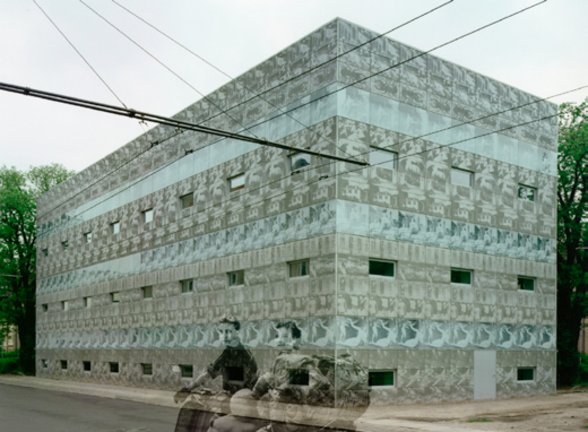
Herzog & de Meuron Bibliothek, Eberswalde, 1999
Thomas Ruff's photographs of the works of the Swiss architects Jacques Herzog and Pierre de Meuron puts less emphasis on the overall form of the building and more emphasis on the surfaces. A reversal of the practices of standard architectural photography, Ruff's pictures provocatively demonstrating that the skin of the building, as well as its form, can convey meaning.1
1Terence Riley Architecture as subject

SURFACE TENSION:
THOMAS RUFF

Interior 1a, 1979
C-print
C-print

SURFACE TENSION:
THOMAS RUFF
Interior 1E, 1983
C-print
C-print

  SURFACE TENSION: THOMAS RUFF House Number 7, 1983 C-print http://www.tate.org.uk/magazine/issue5/ruff.htm |
Jeff Wall
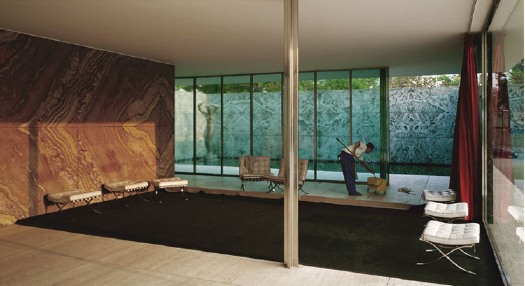
Jeff Wall, Morning Cleaning, Mies van der Rohe Foundation, Barcelona, 1999, 1.8m x 3.5m [image via tate.org.uk]
Jeff Wall's portriat of the German Pavilion designed by Ludwig Mies van der Rohe for the 1929 World fair in Barcelona virtually rivals the building's liquid spatiality, exquisite composition and lush materality. Instead of a smaller scale works, which an seem like a window that one peers through, the oversized scale of Wall's photograph envelopes the viewer, drawing him into the work.Wall's shot captures the moment when sunlight penetrates nearly horizontally into the interior and seems to ignite the floating onyx partition, providing an architectural mirror, if not rival, to the rising sun.2
2Terence Riley Architecture as subject
Architecture without shadow. Edited by Gloria Moure
Andreas Gursky

Times Square 1997

Kamiokande

Untitled

No comments:
Post a Comment